Bearings
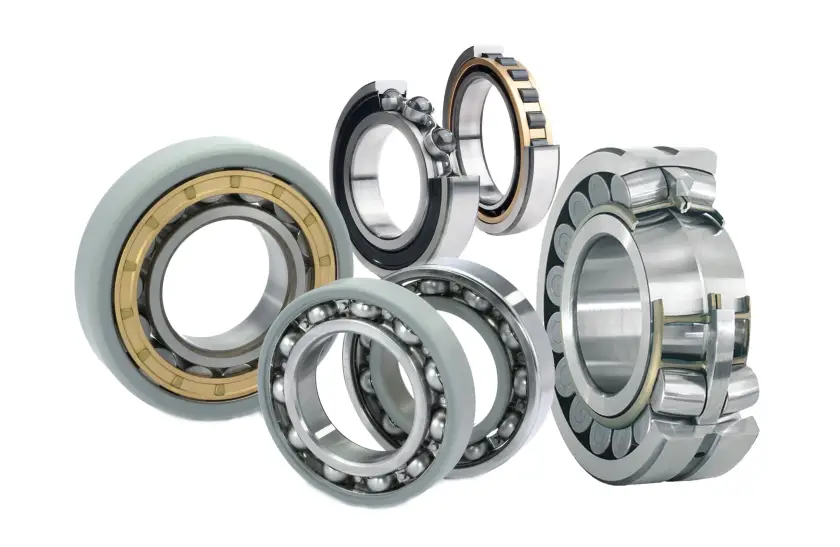
Industrial bearings — deep groove ball, taper roller, spherical, cylindrical and needle types in standard metric and inch sizes for rotating equipment.
- Common types
- Deep groove ball, angular contact, taper roller, spherical roller, cylindrical roller, needle, thrust
- Housed units
- Plummer block, pillow block, flange units
- Bore range
- Typically from miniature sizes up to large-bore industrial bearings
- Sealing options
- Open, metal shield (ZZ), rubber seal (2RS)
- Internal clearance
- Normal (CN), C3, C4 for higher operating temperatures
- Dimensional standard
- ISO 15 (radial bearings), ISO 492 tolerances
About Bearings
Bearings carry load and reduce friction wherever a shaft rotates, from conveyor idlers and pumps to gearboxes, motors and heavy rolling mills. Choosing the right one comes down to the direction and size of the load, shaft speed, operating temperature and how much misalignment the assembly has to absorb.
Deep groove ball bearings cover most general-purpose radial duties and accept moderate axial loads. Taper roller bearings take combined radial and thrust loads in wheel hubs and gear units. Spherical roller bearings handle heavy loads and shaft deflection, and cylindrical roller bearings suit high radial loads at speed. Needle bearings fit tight spaces, while thrust bearings and plummer block or pillow block units cover axial loads and simple shaft mounting. Boundary dimensions generally follow ISO 15, so a bearing number can be crossed between manufacturers, and ISO 492 defines tolerance classes. Open, shielded (ZZ) and sealed (2RS) versions, along with internal clearance options such as C3 for hotter running, should be matched to the environment and fit.
Shlok Trading Co. sources bearings by part number, by dimensions, or by the equipment they go into. Share the existing bearing code or the bore, outside diameter and width, and our team will help match a suitable replacement.
Bearings FAQs
Can you supply a bearing if I only have the old part number?
Yes. Standard bearing designations are largely interchangeable across manufacturers, so the number stamped on the old bearing is usually enough to identify an equivalent.
What does C3 clearance mean?
C3 means the bearing has more internal clearance than normal. It allows for thermal expansion in hot-running or tight-fit applications such as electric motors.
Should I choose a shielded or a sealed bearing?
Metal shields (ZZ) keep out larger debris with low friction. Rubber seals (2RS) keep out dust and moisture better but run slightly warmer and at lower limiting speeds.
Need Bearings?
Share your grade, size and quantity requirements and our team will get back to you with availability and a quote.